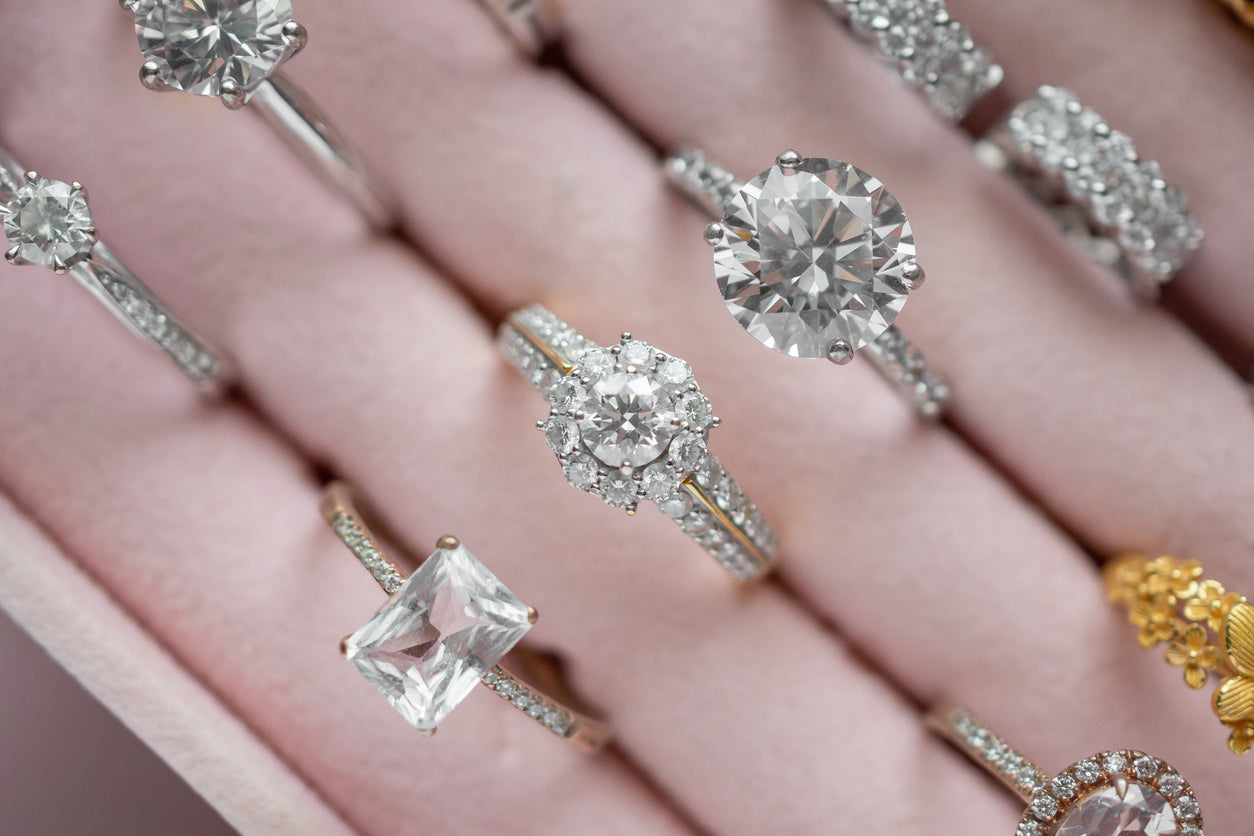
Once you’ve chosen a diamond, there’s another important decision to make: how do you want the ring to look, and how do you want the diamond or gemstones to be held in place?
This can get confusing because the word setting has two different meanings when it comes to engagement rings. It can describe the overall design of the ring, such as a solitaire, halo, or three-stone setting. It can also describe how a diamond or gemstone is secured, such as with prongs, a bezel, or a pavé setting.
Understanding the difference will make it much easier to describe what you like when you shop for an engagement ring. And you don’t have to choose just one style. Many of the terms used to describe engagement rings can be combined to create a ring with several distinct features.
Think of an engagement ring as a collection of building blocks.
A ring might have a halo design, a cathedral shank, a split shank, and pavé-set diamonds. Each term describes something different about the ring.
If you’re still deciding what you like, don’t worry about knowing the terminology ahead of time. Looking at a wide range of engagement ring styles and trying different designs on your finger can help you discover what feels right.
What Does “Setting” Mean?
When you’re shopping for an engagement ring, you may hear the word “setting” used in several ways.
An engagement ring setting style describes the overall design and arrangement of the ring. A solitaire, halo, three-stone, and toi et moi are examples.
A stone setting describes how an individual diamond or gemstone is held in the ring. Prong, bezel, pavé, and channel are examples.
There are also terms that describe the shape or construction of the band and terms that describe the aesthetic or historical influence of a ring.
These categories overlap, so a single ring can have several different descriptions.
One engagement ring can combine several design features and stone-setting techniques.
One Ring, Several Descriptions
For example, imagine a ring with an oval center diamond surrounded by two rows of smaller diamonds. The shoulders of the ring rise toward the center stone, and smaller diamonds cover part of the band.
You might describe it as a:
Double-halo ring because it has two halos around the center stone
Cathedral setting because the shoulders rise toward the center
Pavé setting because small diamonds are set closely together along the band
Prong setting because prongs hold the center diamond
All four descriptions can be correct. They simply describe different parts of the same ring.
Engagement Ring Setting Styles
These styles generally describe the overall arrangement and appearance of an engagement ring. They aren't mutually exclusive. A ring can combine several of them.
Solitaire
A diamond solitaire engagement ring with a round brilliant-cut diamond in a six-prong setting.
A solitaire engagement ring has one prominent center stone with little or no additional decoration surrounding it.
Because there are fewer elements competing for attention, a solitaire puts the focus squarely on the center diamond or gemstone. It is a particularly versatile choice because the design can be simple and modern, ornate and vintage-inspired, or anything in between.
A solitaire can also be combined with other features. For example, a solitaire can have a cathedral shank, split shank, pavé band, or a distinctive vintage-inspired design.
A diamond halo engagement ring with a center round brilliant-cut diamond framed by a cushion-shaped halo of diamonds.
A halo setting surrounds the center stone with a row of smaller diamonds or gemstones.
A halo can add sparkle around the center stone and create the appearance of a larger overall ring. The shape of the halo can also follow the shape of the center stone. A round diamond might have a round halo, while an oval, cushion, or emerald-cut diamond can have a halo designed specifically for its shape.
Halos can also be combined with other styles. A ring might have a halo and cathedral shank, or a double halo and split shank.
A double halo diamond engagement ring in a white gold setting. The center diamond is cushion-shaped with two surrounding cushion-shaped halos.
A double halo takes the halo concept one step further, surrounding the center stone with two rows of smaller stones.
This creates a larger, more dramatic look and adds substantial sparkle around the center diamond. Double halos can be especially striking with elongated shapes such as oval, emerald, radiant, and pear-shaped diamonds.
Three-Stone
A three-stone diamond engagement ring in a yellow gold setting containing a center round brilliant-cut diamond and two pear-shaped side diamonds.
A three-stone engagement ring features three prominent stones arranged across the top of the ring. The center stone is usually the largest, with two smaller stones on either side.
Three-stone rings can have a traditional, modern, or vintage-inspired appearance depending on the shapes of the stones and the rest of the design.
The three stones can also be combined with halos, side stones, cathedral shoulders, or other details.
A yellow gold diamond engagement ring with accent diamonds in the shoulders of the band and in the gallery area beneath the center diamond.
Side-stone engagement rings feature smaller diamonds or gemstones alongside the center stone.
The side stones can add extra sparkle without completely surrounding the center stone like a halo. They can be arranged in many ways, from a few accent diamonds near the center to diamonds covering much of the shank.
Side stones may be prong-set, pavé-set, channel-set, or secured using other setting techniques.
Cluster
An antique Victorian diamond cluster engagement ring. While this type of cluster is not common for modern engagement rings which favor a distinct center stone, you can find diamond clusters as accents to the center stones.
A cluster ring groups multiple diamonds or gemstones closely together to create a larger visual design.
Unlike a traditional solitaire, a cluster can use several stones to create the appearance of one larger centerpiece or a distinctive floral, geometric, or other shape.
Cluster designs have a long history in jewelry and can be particularly appealing if you like vintage or antique-inspired styles.
Toi et Moi
A minimalist toi-et-moi diamond engagement ring in a white gold setting.
Toi et moi, French for “you and me,” describes a ring with two prominent stones facing or sitting beside each other.
The two stones can be the same shape and size, or they can be completely different. For example, an oval diamond could be paired with a pear-shaped diamond.
This is one of the more distinctive engagement ring styles, especially if you want something that feels less traditional than a solitaire or halo.
Bypass
A rose gold diamond bypass engagement ring. This ring is also an example of a solitaire engagement ring.
A bypass ring has two sides that curve around the center or cross past one another rather than meeting in a traditional straight band.
Bypass designs can create a sense of movement and are particularly interesting when the two sides of the ring frame different gemstones or diamonds.
A bypass design can also overlap with other styles. For example, a bypass ring might incorporate a halo, two prominent center stones, or pavé-set diamonds.
Cathedral
A cathedral setting has raised shoulders that sweep upward toward the center stone.
A diamond engagement ring with cathedral-style shoulders accented by diamonds.
The name comes from the resemblance between these curved or arched metal supports and the arches of a cathedral. The raised design can give the center stone additional visual prominence and create an elevated appearance.
Cathedral describes the construction of the ring, rather than the number or arrangement of its gemstones. A solitaire, halo, or three-stone ring can all have cathedral-style shoulders.
Split Shank
A split-shank ring has a band that separates into two or more sections as it approaches the center stone.
This wedding ring set or bridal ring set features a diamond engagement ring with split-shank shoulders.
The split can be subtle or dramatic. It can also create space for additional diamonds, giving the ring a more intricate appearance.
A split shank can be combined with many other designs, including halos, double halos, solitaires, and three-stone rings.
East-West
An east-west setting places an elongated gemstone horizontally across the finger rather than positioning it vertically.
A diamond halo engagement ring with the center pear-shaped diamond in an east-west orientation.
This orientation can give a familiar diamond shape a completely different appearance. Oval, emerald, marquise, and other elongated stones can all be used in east-west designs.
If you like a traditional diamond shape but want something less conventional, changing its orientation can make a surprisingly big difference.
Vintage and Antique-Inspired Styles
Some engagement ring terms describe a historical period or design aesthetic rather than one particular ring construction.
For example, Art Deco is not one specific setting style. An Art Deco ring might be a halo, cluster, three-stone, or another design. What makes it Art Deco is the overall aesthetic, which often includes geometric shapes, symmetry, contrasting materials, and intricate details.
An antique Art Deco engagement ring featuring a center old mine-cut diamond with blue sapphire accents and etched details.
Other historical influences include:
Victorian: Romantic and decorative designs associated with the Victorian era
Edwardian: Delicate, ornate designs often featuring intricate metalwork and open patterns
Art Nouveau: Flowing, organic shapes inspired by nature
Art Deco: Geometric designs, symmetry, bold contrasts, and architectural details
Retro: Sculptural designs and bold forms associated with the 1930s and 1940s
A modern ring can also be vintage-inspired without being an actual antique.
Remember: A term like “Art Deco” tells you about the ring's aesthetic and historical influence. A term like “halo” tells you about its design. A term like “prong” tells you how its stones are secured.
That distinction can help you make sense of the many terms you’ll encounter while shopping.
Now that we’ve covered overall ring styles, let’s look at the other meaning of “setting”: how diamonds and gemstones are held in place.
Prong Setting
A prong setting uses small metal claws to hold a diamond or gemstone in place.
Within prong settings, there are several variations.
Four- and six-prong settings are common for center diamonds. Prongs allow a substantial amount of the stone to remain visible and can allow light to enter from several directions.
The shape of the prongs can also affect the look of the ring. V-shaped prongs, for example, can provide additional protection around the pointed ends of pear- and marquise-shaped stones.
Bezel Setting
A bezel setting surrounds the edge of a diamond or gemstone with a rim of metal.
Because the metal extends around the stone, a bezel can provide substantial protection for the edges of the gemstone. It also creates a clean, streamlined appearance.
A bezel can surround the entire stone or cover only part of its perimeter.
Pavé Setting
Pavé, pronounced “pa-vay,” comes from the French word for “paved.” In a pavé setting, small diamonds are set closely together in the metal so that the surface appears covered with a continuous field of sparkle.
Most of these settings will apply to the accent stones and not the center stone of an engagement ring.
Pavé can be used along a ring's shank, around a halo, or in other areas of the design.
Micro-Pavé
Micro-pavé uses especially small diamonds set closely together.
The tiny stones can create an intricate, highly detailed appearance while keeping the amount of visible metal relatively low.
Micro-pavé is often associated with delicate and highly detailed engagement rings.
French Pavé
French pavé is a style of pavé setting in which the metal is shaped to create small openings or grooves beneath the diamonds.
This can allow more of each diamond to remain visible while creating a delicate, detailed appearance.
Shared-Prong Setting
In a shared-prong setting, one set of prongs can hold adjacent stones rather than giving each stone its own complete set of prongs.
This reduces the amount of metal visible between stones and can create a continuous row of sparkle.
Shared prongs are commonly used for bands and rows of accent diamonds.
Channel Setting
A channel setting holds diamonds or gemstones between two parallel walls of metal.
Because there are no individual prongs separating each stone, a channel-set row has a smooth, continuous appearance.
Channel settings are commonly used for wedding bands and accent sections of engagement rings.
Bar Setting
In a bar setting, small diamonds are held between narrow vertical bars of metal.
The bars separate the stones while allowing more of the sides of the diamonds to remain visible than in a traditional channel setting.
Flush Setting
A flush setting places a diamond or gemstone directly into the surface of the metal so that the stone does not rise significantly above it.
This creates a low-profile, streamlined look and can be particularly practical for people who prefer jewelry that doesn't catch easily on clothing or other objects.
Tension Setting
A tension setting uses pressure from the metal on opposite sides of the gemstone to hold it in place. The result can make the center stone appear to float between the two sides of the ring.
Tension settings require specialized construction and are generally used with durable gemstones.
Invisible Setting
An invisible setting uses specially cut stones and a concealed framework beneath them so that little or no metal is visible from above.
The result can look like a continuous surface of gemstones. This technique requires precise cutting and setting and is often used for dramatic, highly detailed designs.
Decorative Details Can Add Even More Character
Not every term you encounter describes the primary way a stone is secured.
For example, milgrain refers to tiny beads of metal applied along an edge. It is especially common in vintage and antique-inspired jewelry.
A diamond solitaire engagement ring with a milgrain halo. Milgrain accents can be used in a variety of ways to add detail to an engagement ring.
Milgrain can be paired with prong, pavé, bezel, or other settings. In other words, a ring can have a bezel-set center stone with milgrain detailing, or pavé-set diamonds with milgrain along the edges.
This is another example of why engagement ring terminology can seem complicated at first. Different terms can describe different layers of the same design.
How Diamond Shape Affects Your Setting Choices
Your diamond shape can influence which settings will work well visually and mechanically.
Diamond Shape
Setting Considerations
Round
Extremely versatile and works with many setting styles
Oval
Works well in solitaire, halo, three-stone, and east-west designs
Pear
V-shaped prongs can help protect the pointed tip
Marquise
V-shaped prongs can help protect both pointed ends
Emerald
Bezel and prong settings can work well; the open facets make clarity especially important
Asscher
Geometric settings can complement its architectural appearance
Cushion
Works beautifully with halos, solitaires, three-stone, and vintage-inspired designs
Radiant
Versatile enough for halos, solitaires, three-stone, and other designs
One engagement ring can combine multiple different diamond shapes depending on its design.
The shape of the diamond doesn't dictate the setting you have to choose. Instead, it gives you another factor to consider when deciding what you like and how you want the finished ring to look. Check out our diamond education page for a deep-dive into diamonds.
Ready to explore the process of buying a diamond? Check out our expert guide on how to buy a diamond.
With so many combinations available, how do you narrow them down?
Start with what you already know you like. You may be drawn to a particular diamond shape, a certain metal color, a vintage look, or a ring with lots of sparkle.
Your personal style: Do you prefer clean and minimal, romantic and detailed, geometric and modern, or ornate and vintage-inspired?
Your lifestyle: Consider how often you wear jewelry, what you do with your hands, and whether you prefer a low-profile design.
Your diamond shape: Some settings emphasize certain characteristics of a diamond more than others.
Your desired amount of sparkle: A solitaire creates a very different effect from a double halo with pavé diamonds.
Your wedding band: Think about how the engagement ring and wedding band will fit together. Some engagement rings allow a straight wedding band to sit flush against them, while others may require a contoured, curved, or custom-fit band.
Your budget: The setting itself contributes to the overall cost of the ring. Additional diamonds, intricate metalwork, and specialized setting techniques can all affect the price.
Still sorting through the options for choosing an engagement ring? Check out our expert guide on how to buy an engagement ring.
Don't Be Afraid to Try Something Unexpected
You may walk into a jewelry store thinking you want a classic solitaire and discover that you love a three-stone ring. Or you may expect to want a halo and realize that an east-west bezel setting feels much more like you.
That's one reason it's worth trying on a wide variety of engagement ring styles.
Looking at the most popular designs gives you a starting point, but unusual designs can help you figure out what you actually like. Sometimes seeing what feels too much can be just as helpful as finding the ring that feels just right.
Estate and vintage jewelry can be especially useful for this. Older rings often feature design combinations that aren't as common in contemporary jewelry, giving you the opportunity to see different proportions, details, gemstones, and setting techniques.
Create an Engagement Ring That's Uniquely Yours
You don't necessarily have to choose a ring that fits neatly into one category.
A ring can combine a halo with cathedral shoulders, a double halo with a split shank, or a vintage-inspired design with modern setting techniques. Custom jewelry gives you even more freedom to combine the features you love.
At Nelson Coleman Jewelers, our jewelry experts can help you compare different engagement ring styles, understand how different settings work, and find a combination that suits your diamond, your lifestyle, and your personal style.
Whether you're drawn to a classic solitaire, an elaborate vintage design, or something completely unexpected, exploring different settings is one of the most enjoyable parts of choosing an engagement ring.
Frequently Asked Questions About Engagement Ring Settings
What is the difference between an engagement ring style and a setting?
An engagement ring style generally describes the overall design of the ring, such as a solitaire, halo, or three-stone ring. A setting can also refer to how the diamond or gemstone is secured, such as with prongs, a bezel, or pavé. The terms can overlap, so it's helpful to look at the specific context.
Can an engagement ring have more than one setting style?
Yes. Many engagement rings combine several design elements. For example, a ring can have a halo, cathedral shoulders, a split shank, and pavé-set diamonds. These terms describe different parts of the ring.
What is the most popular engagement ring setting?
Solitaire and halo designs are among the most familiar engagement ring styles, but popularity changes over time and varies from person to person. The best way to determine what suits you is to compare different styles and try them on.
What engagement ring setting is the most secure?
Security depends on the specific design, construction, gemstone, and quality of the setting rather than one setting type being universally the most secure. Prongs, bezels, and other setting methods each have different characteristics and considerations.
Can I combine different engagement ring styles?
Absolutely. Combining design elements is one of the ways engagement rings get their individual character. A halo can have cathedral shoulders. A double halo can have a split shank. A three-stone ring can have pavé-set accent diamonds. The possibilities are extensive.
How do I know which engagement ring setting is right for me?
Start by trying on a variety of styles rather than choosing based only on pictures. Consider your diamond shape, personal style, lifestyle, preferred metal, desired amount of sparkle, and how you want the engagement ring to work with your wedding band. A jewelry professional can also help you compare options and identify combinations that fit your priorities.
Find Your Engagement Ring Setting at Nelson Coleman Jewelers
Choosing an engagement ring doesn't have to mean knowing every jewelry term before you begin. Our team can help you understand the differences between setting styles, compare options, and find a ring that feels right for you.
Explore our engagement rings or schedule an appointment with Nelson Coleman Jewelers to see different styles and settings in person.
Carrie holds an Applied Jewelry Professional™ certification from the Gemological Institute of America (GIA) and enjoys sharing insights that help jewelry buyers make informed decisions. She has a special interest in estate jewelry, exploring how societal changes, global events, and design movements have influenced the pieces created throughout history.
Sign up and save
Subscribe to get special offers, free giveaways, and once-in-a-lifetime deals.