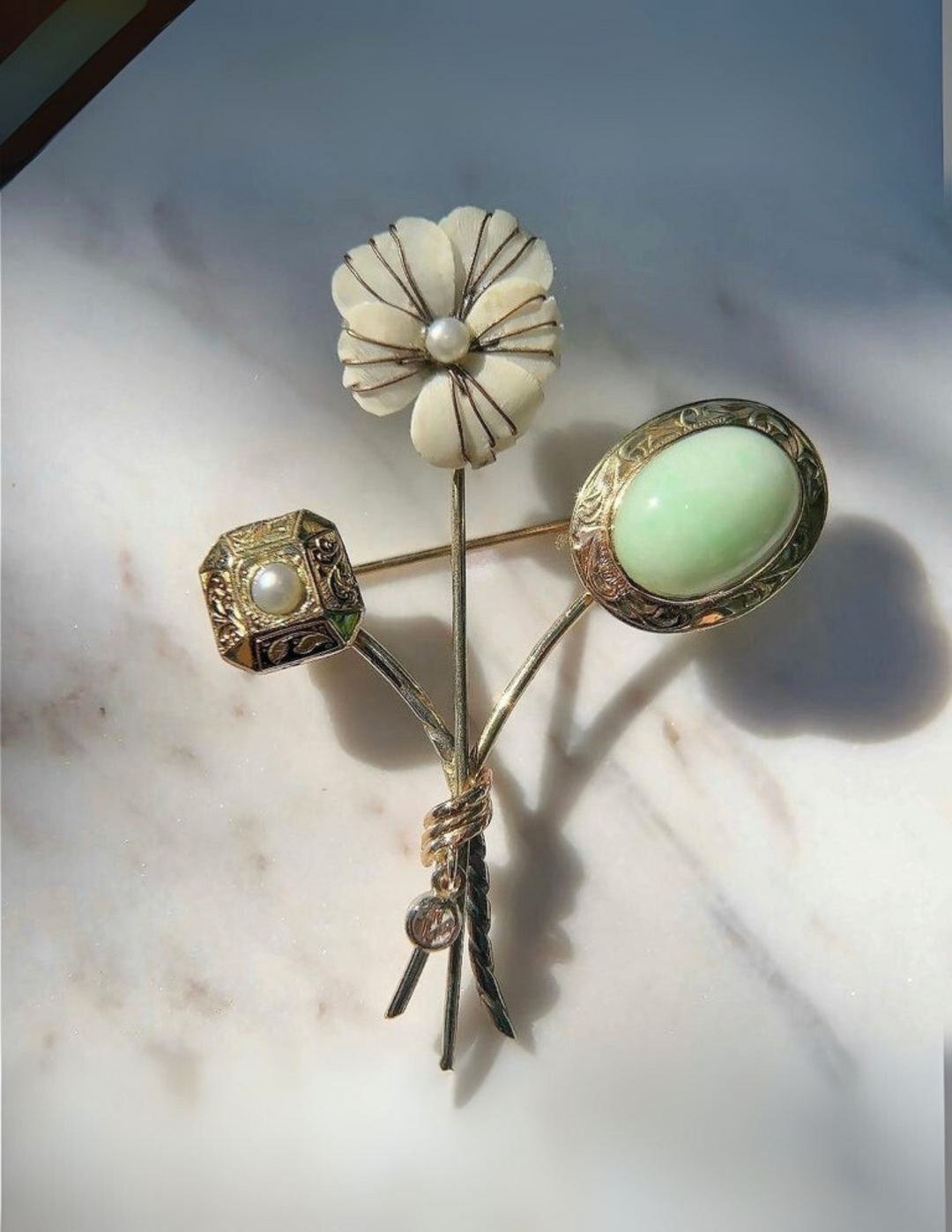
Mid-Century Jewelry: A Reflection of Counterculture
Mid-Century Jewelry: A Reflection of Counterculture




Mid-century jewelry emerged during an exciting era that reflected profound societal changes, particularly for Black Americans and women. While many online sources place mid-century jewelry in the 1950s and 1960s, many jewelry historians place it solely in the 1960s, according to our estate manager. So what exactly is mid-century jewelry, and what is its relevance in history?
I had always read that mid-century jewelry was “mid-century modern” jewelry and essentially synonymous with Scandinavian modernist design. While researching and preparing this article, Emilia Nieman, our estate manager, pointed out to me that “mid-century jewelry” was much more complex than I had thought.
According to Emilia, our esteemed estate manager and GIA Graduate Gemologist with 5+ years of experience, jewelry from the 1950s can be a bit confusing because there’s not a generally agreed-upon term for it. While some elements of the modernist movement can be seen in the 1950s, it’s still a very distinct design era from the 1960s.
“The reason that I (and most other jewelry historians) do not include the 1950s in midcentury is that they are stylistically polar opposites. The confusion, I think, is that the 1950s doesn’t have its own style name, just as the 1910s, 1970s, 1980s, and onward do not have their own style names.
In the 1950s, the preference was for white metal, pearls, and diamonds. It was a return to femininity and purity after the austere war years, and a rejection of anything that reminded them of [the] war years. Yellow and rose metals, therefore, were out of style, and because diamond mines could once again be accessed, diamonds could be used again in jewelry. During the war, it was a focus on color, and any use of diamonds was a reuse of existing family diamonds, which is why we see old cut diamonds in retro jewelry. So, for the 1950s, think June Cleaver with her big skirt and strand of pearls.”

June and Ward Cleaver from the show "Leave it to Beaver" (1957-1963), played by Barbara Billingsley and Hugh Beaumont

Grace Kelly in a promotional photo for the film "Rear Window" from 1954

Audrey Hepburn in Sabrina, 1954
The 1950s were an era of feminine grace, primness, and properness. It was the era of George Henschel’s The Well-Dressed Woman and style icons such as Grace Kelly, Audrey Hepburn, a young Queen Elizabeth, and early Jackie Kennedy. Fashion was largely influenced by French trends, including couturier Christian Dior and design house Cartier. There were also bolder and more minimalist styles during this time, with trends such as the whimsical charm bracelet, Scandinavian modernist design, and textured gold accents.
Several factors helped shape the transformation into the mid-century jewelry design of the 1960s. Christian Dior passed away in 1957, significantly lessening the influence of French trends in jewelry design and making way for Italian fashion design influences such as Gucci and Ferragamo, as well as London’s emerging Mod scene.
Cultural icons in the late 1950s, such as Marilyn Monroe, Ava Gardner, Jayne Mansfield, and Elizabeth Taylor, created a new blueprint for women, albeit somewhat scandalous at the time, of empowered femininity outside of the domestic sphere. Radical feminism also emerged in the 1960s, credited largely to The Feminine Mystique by Betty Friedan, with monumental legislative activity such as the Equal Pay Act passed in 1963 and Title VII of the Civil Rights Act, which prohibits employment discrimination on the basis of race, color, religion, national origin, or sex.
Emila was again able to provide me with a succinct yet thorough summary of what mid-century jewelry really is:
“The 1960s [were] part of the modernist movement, and toward the end, we see the beginning of the brutalist movement. Again, it was a rejection of the styles of the prior decade, and it was the rise of counterculture. Color and texture were [the] main components of design, both in art and fashion, and we see this reflected in the jewelry.
Monochromatic combinations were very fashionable, especially somewhat odd ones like ruby and coral or sapphire and turquoise. Cocktail parties were all the rage, so we see lots of larger cocktail rings during this era and through to the end of the 1970s. Rope details were popular as well as color.
A great example of a jewelry icon of this era was Jackie Kennedy. When she got married in the 1950s, her engagement ring was platinum. But, the rest of her jewelry, while on the world stage, was yellow gold and colorful and in keeping with the modern style.”
As previously mentioned, and as many may be familiar with or have lived through, the 1960s was a time of radical cultural, political, and ideological change. Some of the most prominent influences were radical feminism, the decolonization of more than 40 African countries, the Civil Rights Movement, Martin Luther King, Jr., John F. Kennedy, the Space Race between the U.S. and the Soviet Union, Neil Armstrong's landing on the moon, and the hippie movement. As in many decades before, fashion and design offered an artistic space to explore the cultural, political, and ideological changes taking place.

Dr. Martin Luther King Jr., American, 1929 - 1968, March on Washington for Jobs and Freedom, American, founded 1963

The Feminine Mystique by Betty Friedan, published in 1963, is considered to have had a major impact on 2nd wave feminism

A woman demonstrator offers a flower to a military police officer on guard at the Pentagon during an anti-Vietnam demonstration
Where Grace Kelly and Marilyn Monroe were fashion icons in the 1950s who embodied the Hollywood bombshell, grace, luxury, and femininity, the new icon of the 1960s was exemplified in Twiggy, a London fashion model. In her book Vintage jewelry design: classics to collect & wear, Caroline Cox describes the new trend as “the adrongynous, pre-adolescent figure…sporty, futuristic, even anti-maternal image and pared down geometric clothes made 1950s fashion look too prim, too proper, too grown up – just too plain old.”
Fashion was suddenly aimed more at young people, particularly the post-war baby boomers who were becoming teenagers. Designs emphasized ideas of youthfulness and utilized cheaper materials to make fashion more accessible to the younger target audience. Fine jewelry was still worn, but in a much more casual manner than in the previous era, and wearing a lot of it was considered to make the wearer look “old” in a derogatory sense.
The 1960s was a time when costume jewelry was glorified for several reasons, but generally because it made fashion more accessible to a wider audience. Shifting from diamonds, pearls, platinum, and gold to resin, enamel, Swarovski crystals, and semi-precious stones made jewelry more affordable and, in many cases, reduced its weight, making it easier to wear and allowing for large, statement pieces.
There was also a marked shift in how jewelry trends emerged. In the past, fashion designers had often created trends that were then emulated. In the 1960s, fashion designers were instead inspired by the trends of culture and youth. Public interest in Pop, Op, and Psychedelic art trends inspired bold gemstones set in black metal. Stones like turquoise and tourmaline, as well as colorful enamelwork, became more popular for their perceived beauty instead of their inherent monetary value.

A pair of mid-century 14 karat yellow gold turquoise drop earrings with a bold geometric motif by modernist Danish designer Hans Hansen

A 14 karat yellow gold mid-century necklace by renowned American designer, Betty Cooke

A pair of mid-century 18 karat yellow gold and green enamel clip-on earrings
So what exactly were the styles of the 1960s? As Emilia emphasized, jewelry “eras” are not cut-and-dry, and there’s always going to be fluidity and overlap between one era and another. With that in mind, here are some of the most iconic and popular 1960s jewelry styles.
| Crystal, rhinestone, plastic beads | Often seen in bib & collar necklaces, as well as bracelets. Sometimes mixed with other materials, like pearls. |
| Oversized chandelier earrings | While popular in the 1950s, they were considered a bit scandalous and worn by actresses who existed at and outside the boundaries of traditional femininity. By the 1960s, they were even more oversized and more widely accepted. |
| Bright, primary color palette | A hallmark of 1960s jewelry, it reflected the optimism of the post-war baby boomers |
| Enamel jewelry, especially flowers | Hugely popular in the 1960s, enamel flowers were symbols of “flower power,” a slogan used by the hippie movement. |
| Chunky, geometric designs | Typically made from plastics like Perspex and vinyl |
| Pop Art Jewelry | Influenced by designers like Andy Warhol in the U.S. and Richard Hamilton, a founder of the British Pop Art movement |
| Op Art Jewelry | Inspired by artists such as Bridget Riley, Victor Vasarely, op art jewelry was a relatively short-lived trend, but signalled a shift away from the popularity of figurative forms into abstract designs. |
| Organic shapes | Several jewelry designs from this area explored the use of organic shapes, patterns, textures, and motifs, including Andrew Grima, Georg Jensen, Lapponia, Charles de Temple, and Gillian Packard. |
| Space Age Aesthetic | The Space Age aesthetic affected various facets of design and was heavily popularized in jewelry by the designs of Paco Rabanne, who called it anti-jewelry, saying “I make jewelry for the alternative side of a woman’s personality, for her madness.” Some common Space Age motifs include shooting stars, planets and rocketships. Sigurd Persson was another contributor to Space Age jewelry design. |
| Hippie Movement motifs | Inspired by non-Western cultures, particularly those affected by colonialism. Native American and Indian motifs were popular, as well as more vague references. The flower, especially the daisy, became a powerful symbol for ideas of free love and non-conformist thinking. |
| Victorian Revival jewelry | While brands like Kenneth Lane, Lalounis, Bulgari, and Stein explored various eras like ancient Egypt, ancient Greece, Art Nouveau, Art Deco, it was Victorian Revival jewelry that emerged as the most popular style. |

An Andrew Grima brooch given as a gift by Queen Elizabeth to First Lady Betty Ford

A Victor Vasarely op art design, circa 1968

A Paco Rabanne Space Age motif tunic
While there’s a lot of variation in jewelry designs of the 1960s, author Caroline Cox believes the era’s style can best be summed up by a Richard Hamilton quote:
“[It should be] Popular (designed for a mass audience); transient (short-term solution); expendable (easily forgotten); low cost ; mass-produced; young (aimed at youth); witty; sexy; gimmicky; glamorous; and last but not least, Big Business.”
While the styles of 1960s jewelry may no longer be mainstream, their influence can still be seen in modern jewelry brands with bold designs, such as Bellarri and Le Vian. Not only was the 1960s a stark departure from the styles of the 1950s, but it was also a reflection of the deep social changes of the time that challenged decades of systemic oppression and conformity. Fashion and jewelry, like many other eras, provided an outlet for exploring new ideas and ways of being. What kind of 1960s jewelry would you wear today?
Whether it's mid-century jewelry or jewelry from any era, Nelson Coleman Jewelers offers a complete range of services to bring out the best in your beloved pieces.